Food Factory Set Up

Our Food Processing and Packaging Factory solutions are designed to meet the needs of modern food manufacturing, offering fully automated systems for mixing, cooking, filling, sealing, and packaging of a wide range of products such as sauces, ketchup, mayonnaise, jams, dressings, and ready-to-eat foods.

With a focus on hygiene, precision, and efficiency, every system is engineered using stainless steel construction, PLC automation, and CIP (Clean-in-Place) compatibility. From raw material handling to final product packing, our lines ensure consistent taste, texture, and quality — helping food producers meet international safety standards and market demand with confidence. These lines can be configured for small, medium, or large-scale production, and customized to handle both liquid and semi-solid food products.

Process Systems

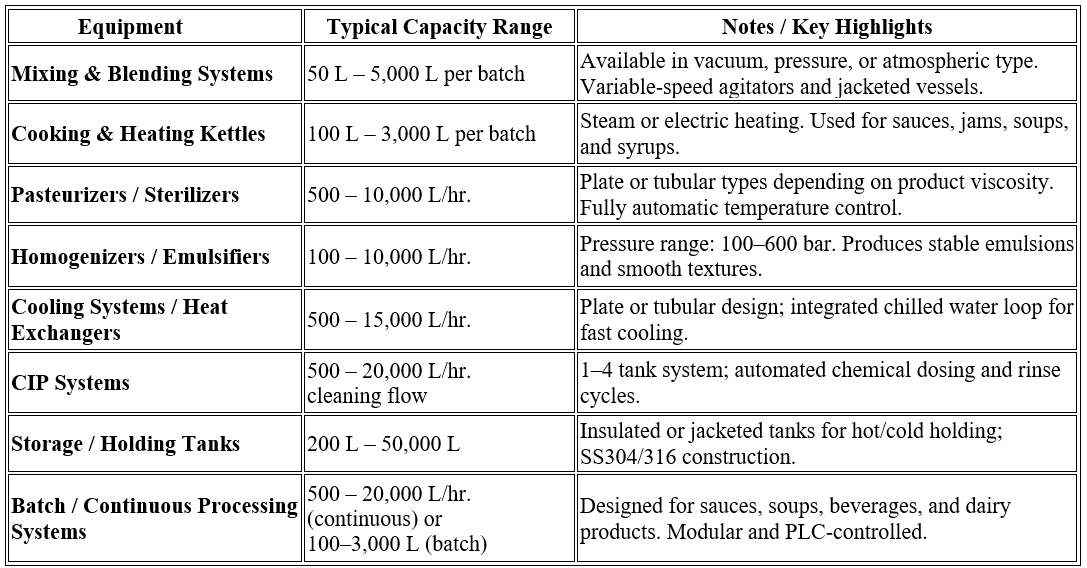
Our food processing systems are designed for precision, hygiene, and efficiency — turning raw materials into consistent, high-quality products. From mixing and heating to pasteurization and homogenization, each process stage is built for reliability and compliance with global food safety standards.

Mixing & Blending Systems (sauces, creams, dressings)

These systems combine raw ingredients—liquid, semi-liquid, powders, emulsions—into uniform mixed batches for sauces, creams, dressings and more. Blending aims for gentle combination of components; mixing (often with high shear) aims for a homogenous, consistent product.

Key Features & Highlights:

      • Blending or mixing mode selectable (ribbon, paddle, high-shear or vacuum) depending on product viscosity.
      • Variable speed agitators and impellers to handle low-viscosity to high‐viscosity materials.
      • Built-in heating/cooling jackets for control of batch temperature.
      • Vacuum or inert gas options for deaeration during mixing (for creams, emulsions).
      • Sanitary design (SS304/316, polished finish) to meet hygiene standards.
      • Easy cleaning access, often CIP compatible.
      • High capacity scale: suitable for small batches up to large industrial volumes.
      • Accurate ingredient dosing and mixing repeatability for consistent product quality.

These vessels are used to cook, heat or pasteurize sauces, jams, soups and semi-solid foods. They allow precise control of temperature, agitation and residence for quality and safety.

Key Features & Highlights:

      • Jacketed or direct steam heating for rapid temperature rise and consistent cooking.
      • Stirring mechanisms (agitators, scrapers) to prevent burning, handle viscous products.
      • Insulated construction to conserve energy and maintain temperature.
      • Temperature sensors, PID / PLC control for automated, accurate heating.
      • Suitable for batch processing (kettle) or continuous cooking as required.
      • Capacity and design customizable for product type (low viscosity, high pulp, chunky sauces).
      • Safety features: pressure relief, explosion-proof (if steam) and hygienic construction.

This equipment ensures food safety and shelf-life by heating products to required temperatures for a specified time, then cooling them. For liquids and semi‐solids, pasteurization or sterilization are essential.

Key Features & Highlights:

      • Plate type for clear, low viscosity products; tubular type for thicker or pulpy products.
      • Regenerative heat exchange to recover energy and improve efficiency.
      • Holding tubes or sections to ensure correct residence time.
      • Automated temperature, flow and pressure control via PLC.
      • CIP-compatible design for hygiene.
      • Construction: SS316L, sanitary welds, minimal dead zones.
      • Accurate temperature control (typically ±0.5 °C) for consistent results.
      • Suitable for juices, sauces, dairy, soups and more.

Homogenizers and emulsifiers are used to create stable emulsions (oil-in-water mixtures, creams) and to reduce particle size so that the product remains uniform and stable over time.

Key Features & Highlights:

      • High shear mixing elements that produce fine droplet sizes for stable emulsions.
      • Capable of handling high-viscosity products (creams, thick sauces) or products needing fine dispersion (dressings, emulsified sauces).
      • Variable pressure/temperature control for customization of product texture.
      • Sanitary design, easy cleaning, often integrated into mixing tanks.
      • Enhances product stability, prevent separation, improves mouth feel and quality.

Cooling systems and heat exchangers remove heat after cooking or pasteurization and bring products to the correct temperature for filling or storage, preserving product integrity.

Key Features & Highlights:

      • Plate or tubular heat exchangers for efficient heat transfer.
      • Closed loop chilled water or glycol system to achieve target temperature.
      • Integrated controls for temperature, flow rate and pressure to maintain optimal conditions.
      • Hygienic, stainless‐steel construction; minimal dead zones for cleaning.
      • Can be used for cooling sauces, creams, beverages or pre-chilled holding tanks.
      • Assists in process continuity by reducing bottlenecks due to long cooling times.

CIP systems automate the cleaning of tanks, pipelines, heat exchangers and equipment without disassembly. They ensure hygiene, reduce downtime and maintain high production efficiency.

Key Features & Highlights:

      • Automated control of cleaning cycles: pre-rinse, chemical wash (alkali/acid), final rinse.
      • PLC/HMI touch screen interface to set cleaning recipes, monitor parameters (flow, temp, pH).
      • Multi-circuit design allows cleaning of multiple lines simultaneously, reducing downtime.
      • Sanitary construction: SS304/316, sealed valves and pumps, minimal operator exposure.
      • Built-in monitoring and logging for compliance (GMP, HACCP).
      • Utility savings: optimized water, chemical and energy usage.

These tanks store raw materials, intermediate blends and finished products. They may include heating/cooling jackets, insulation, sampling ports and transfer pumps.

Key Features & Highlights:

      • Capacity sizes customized to batch size and processing volume.
      • Jacketed construction with heating or cooling circulation (steam, hot water, glycol) for temperature control.
      • Insulated body to maintain temperature and reduce energy loss.
      • Sanitary access: manhole, CIP spray balls, sampling ports and level sensors.
      • Food-grade stainless steel (SS304/316) with polished interior finish for hygiene.
      • Integrated instrumentation: level sensors, temperature, pressure, PLC interface.
      • Suitable for storage of water, syrups, blends, final product.

These refer to entire systems that either process food in defined batches (batch processing) or continuously feed product through a processing line (continuous processing). The choice depends on product type, volume, flexibility and footprint.

Key Features & Highlights:

      • Batch systems: high flexibility, easy changeover for different products, suitable for small/medium production.
      • Continuous systems: high throughput, minimal manual intervention, optimized for large scale production.
      • Fully automated controls: recipe management, PLC, HMI interface, integrated data logging.
      • Modular design enabling scalability and quicker installation.
      • Efficient resource utilization – energy, water, labour; reduced wastage.
      • Integration with upstream & downstream equipment (mixers, cookers, fillers, conveyors).

Packing Systems

We provide advanced packaging systems tailored for sauces, jams, dairy, and ready-to-eat foods. Designed for speed and accuracy, our machines ensure every jar, pouch, or bottle is filled, sealed, and labeled with perfection — maintaining freshness, extending shelf life, and enhancing presentation.

Bottle Filling & Capping Machines (sauces, oils, beverages)

Automatic system for filling liquid or semi-viscous products into bottles with high accuracy and secure capping. Ideal for sauces, oils, and beverages.

Applications:

      • Sauces, edible oils, beverages, syrups, dressings

Filling Type:

      • Volumetric piston filling (for viscous liquids)
      • Gravity or overflow filling (for thin liquids)
      • Servo pump or flow meter systems (for accuracy and hygiene)

Capacity Range:

      • 1,000 – 12,000 bottles/hour (depending on product & bottle size)

Key Highlights:

      • Fully automatic rinse–fill–cap monoblock design
      • Available for PET, HDPE, and glass bottles
      • No-bottle-no-fill and no-cap-no-run safety systems
      • Quick changeover between SKUs
      • Optional hot-fill, cold-fill, or aseptic configuration
      • Integrated CIP connection for sanitation

Designed for filling viscous food items like jams, pastes, and soups into jars or cans and sealing them for long shelf life.

Applications:

      • Jams, sauces, ketchup, soups, paste products

Filling Type:

      • Servo piston or auger filling
      • Vacuum or pressure filling for viscous materials

Capacity Range:

      • 800 – 6,000 jars/cans per hour

Key Highlights:

      • Suitable for both glass jars and metal/aluminum cans
      • Heated hopper with agitation to maintain product temperature
      • High-accuracy dosing within ±1%
      • Option for automatic lid placing and seaming system
      • Ideal for thick, chunky, or high-solid content products

High-speed machine for packing liquids, powders, or pastes into preformed or form-fill-seal pouches with precise dosing.

Applications:

      • Sauces, spices, powders, instant foods, ready-to-eat meals

Filling Type:

      • Vertical Form Fill Seal (VFFS) or Horizontal Form Fill Seal (HFFS)
      • Auger, piston, or liquid pump filling depending on material type

Capacity Range:

      • 30 – 120 pouches/min (single or multi-lane)

Key Highlights:

      • Fully automatic film unwinding, forming, filling, sealing, and cutting
      • Multi-lane options for high productivity
      • Compatible with laminated, aluminum foil, or PE films
      • Accurate dosing using servo control
      • Optional date coding, tear notch, and zip-seal options

 Applies product and brand labels with precision and prints batch or expiry codes automatically.

Applications:

  • Bottles, jars, cans, pouches, cartons

Labeling Type:

  • OPP wrap-around, self-adhesive sticker, shrink sleeve, or paper glue labels

Capacity Range:

  • Up to 24,000 bottles/hour (depending on system type)

Key Highlights:

  • Servo-driven label applicators for precision placement
  • Integration with inkjet or laser coding for batch/date info
  • Suitable for round, square, or irregular containers
  • Compact modular design for easy line integration
  • Low-maintenance and tool-free adjustments

Bundles bottles or jars into shrink packs or cartons for easy transport and storage.

Applications:

      • Bottle packs, jar packs, cans, or pouches in groups

System Type:

      • Sleeve type, L-bar, or bundle wrapping
      • Automatic carton erector, loader, and sealer

Capacity Range:

      • 6 – 60 packs/min (depends on pack format)

Key Highlights:

      • Transparent or printed film options
      • Energy-efficient shrink tunnel with precise temperature control
      • Carton sealing via hot melt or tape
      • Compact design for end-of-line integration
      • Reduces manual labor and improves packaging consistency

Transfers containers smoothly between each stage of production with adjustable speed and synchronized flow.

Applications:

      • Transport between filling, labeling, packing, and palletizing stations

Types:

      • Air conveyors (for empty bottles)
      • Flat belt / modular conveyors (for filled containers)
      • Roller or chain conveyors (for cartons/pallets)

Capacity Range:

      • Speed adjustable: 5 – 60 m/min

Key Highlights:

      • Stainless steel frame with hygienic design
      • Smooth product transfer to prevent damage or tipping
      • Integrated sensors and line synchronization
      • Option for accumulation tables and buffer conveyors
      • Modular layout customizable for factory space

Stacks cartons or shrink packs onto pallets automatically, reducing manual labor and improving logistics efficiency.

Applications:

      • Finished product palletizing for bottles, boxes, or bags

System Type:

      • Robotic or layer palletizer
      • Semi or fully automatic bagging

Capacity Range:

      • 5 – 30 bags/pallets per minute

Key Highlights:

      • Reduces manual handling and increases line efficiency
      • Compatible with shrink-wrapped or boxed products
      • Adjustable gripper for multiple package sizes
      • Integrated pallet dispenser and stretch wrapping unit
      • Improves safety, speed, and stacking accuracy

Inspection Systems

Our inspection and quality control solutions guarantee that every product leaving your factory meets the highest standards of safety and precision. With metal detectors, vision systems, and automated checkweighers, we help food manufacturers achieve complete confidence in every batch produced.

A metal detector is an essential quality control system in food production, designed to detect and remove any metallic contaminants (ferrous, non-ferrous, and stainless steel) from products before packaging or dispatch. It ensures product safety, maintains brand reputation, and complies with international food safety standards.


Type                                   Application                                            Product Example

Conveyor Type                  Finished packed food                             Bottles, pouches, cartons

                                            Bulk food detection                                 Unpacked product, raw material,

Gravity Type                      Powder or granular products                 Flour, sugar, spices

Pipeline Type                    Liquid, paste, or semi-fluid food            Sauces, dairy, beverages


 An X-Ray Inspection System is an advanced quality control solution used in food, beverage, and pharmaceutical production lines to detect a wide range of contaminants — including metal, glass, stone, bone, plastic, and rubber — that traditional metal detectors may miss. It ensures superior product safety and compliance with global food standards.

Key Features

  • Detects metallic and non-metallic contaminants, regardless of packaging material.
  • High-resolution X-ray imaging with automatic defect recognition.
  • Detects density variations, missing products, or broken items.
  • Hygienic stainless steel (SS304/316) construction for food-grade environments.
  • User-friendly touchscreen interface with recipe storage.
  • Automatic reject mechanism for contaminated products.

Available models and designs are

  • Standard xray
  • Compact economical system
  • Belt type xray
  • Bulk type xray
  • Pipe type xray
  • Single beam xray
  • Dual beam xray
  • Triple beam xray
  • Quad beam xray
  • Xray for bottle/jar
  • Xray for fish/meat bones
  • Xray for frozen items
  • Xray for nuts/vegetables
  • Xray for packed products
  • Xray for large packages

A Checkweigher Machine is an essential part of food, beverage, and cosmetics production lines — used to automatically verify product weight and ensure every item meets preset standards. It helps maintain product quality, reduce material waste, and comply with weight regulations.

Key Features:

      • High-speed, high-accuracy weighing (±0.1–0.5 g depending on model).
      • Automatic rejection system for underweight or overweight items.
      • Touchscreen HMI for easy setup and operation.
      • Stainless steel frame (SS304) for hygiene and corrosion resistance.
      • Data recording & USB export for traceability and quality reports.
      • Compatible with metal detector and X-ray systems for integrated inspection.

Technical Specifications:

      • Weighing range: 5 g – 50 kg (customizable)
      • Accuracy: ±0.1 – ±1.0 g
      • Speed: Up to 250 pcs/min
      • Display: 10–15” touchscreen
      • Reject options: Air jet, pusher, or drop gate
      • Power supply: AC 220V / 50–60Hz

An Optical Sorting Machine is an advanced quality control system that uses high-resolution cameras, sensors, and AI algorithms to automatically detect and remove defective or contaminated products. It’s widely used in food processing industries for sorting grains, nuts, fruits, vegetables, and other bulk materials — ensuring consistent quality, color uniformity, and product safety.

Key Features:

      • Multispectral cameras (RGB, NIR, IR, UV) for detecting color, shape, and structural defects.
      • AI-based recognition system for precise sorting of impurities, discoloration, or foreign objects.
      • High-speed ejectors for accurate separation with minimal product loss.
      • Touchscreen HMI for recipe storage and easy operation.
      • Self-cleaning system for continuous performance and low maintenance.
      • Constructed with food-grade stainless steel (SS304/316) for hygiene compliance.

      Applications:Category                                                        Product Examples

      Dry Food Sorting                                                                  Rice, pulses, nuts, coffee beans, seeds

       Fresh Produce Sorting                                                        Fruits, vegetables, berries

       Processed Food Sorting                                                     Frozen foods, snacks, cereals

Technical Specifications:

      • Capacity range: 500 kg/hr – 15,000 kg/hr (model-dependent)
      • Accuracy: ≥99.8% defect removal
      • Sorting channels: 32–256 channels
      • Reject system: Air jet or mechanical flap
      • Power supply: AC 220V / 50–60Hz
      • Interface: 10–15” touchscreen with data logging

Leak and Pressure Testing Equipment

Temperature and pH Monitoring Systems

Sampling and Laboratory Testing Instrument

Utilities

Water Treatment System (RO + Softening + Filtration)

Provides purified and mineral-balanced process water for product formulation, cleaning, and cooling.

Features & Highlights:

      • Multi-stage filtration (sand, carbon, micron filters)
      • RO membranes for salt and mineral removal
      • UV and Ozone sterilization for microbial safety
      • Stainless steel storage tanks with level sensors
      • Capacity: 1,000 – 50,000 L/hr (customizable)

Supplies clean, dry, and pressurized air for pneumatic valves, capping, labeling, and conveying systems.

Features & Highlights:

      • Low-pressure (LP) compressor for control air (7–10 bar)
      • High-pressure (HP) compressor for PET blowing or pneumatic tools (30–40 bar)
      • Air dryers and filters for oil-free output
      • Capacity: 2 – 100 m³/min

Generates steam for product heating, sterilization, and CIP operations.

Features & Highlights:

      • Diesel, gas, or electric-fired options
      • Capacity range: 300 – 5,000 kg/hr
      • High-efficiency burners and safety valves
      • Automatic feed water control and pressure monitoring

Provides chilled water or glycol for product cooling, heat exchanger operation, and jacketed tank systems.

Features & Highlights:

      • Water chiller or glycol unit with integrated condenser
      • Temperature control range: 0–10°C
      • Capacity: 2 – 500 TR
      • Energy-efficient scroll or screw compressor design

Automated cleaning system for tanks, pipelines, and filling equipment without manual intervention.

Features & Highlights:

      • 2–4 tank system (caustic, acid, rinse, recovery)
      • Steam or electric heating for detergent solution
      • Flow rate: 1,000 – 20,000 L/hr
      • PLC control for cleaning cycle automation

Ensures stable and safe power supply to all factory machines and utilities.

Features & Highlights:

  • Main control panel (MCC) and sub-panels
  • Backup generator for uninterrupted operation
  • Energy monitoring and overload protection
  • Cable trays and insulated wiring per IEC standards

Interconnects water, steam, air, and product flow lines throughout the plant.

Features & Highlights:

      • Stainless steel sanitary piping for product lines (SS304/316L)
      • Insulated pipelines for steam and chilled water
      • Hygienic design with tri-clamp fittings
      • Pressure-tested for safety and leakage-free operation

Maintains clean air conditions and temperature control in processing and filling rooms.
Features & Highlights:

  • Air Handling Units (AHUs) with HEPA filters
  • Positive pressure zones for hygiene-critical areas
  • Humidity and temperature control (20–25°C, 60% RH)
  • Ducting network in SS or aluminum