
Factory Design Services for Food, Beverage, Cosmetics & Plastic Industries
October 19, 2026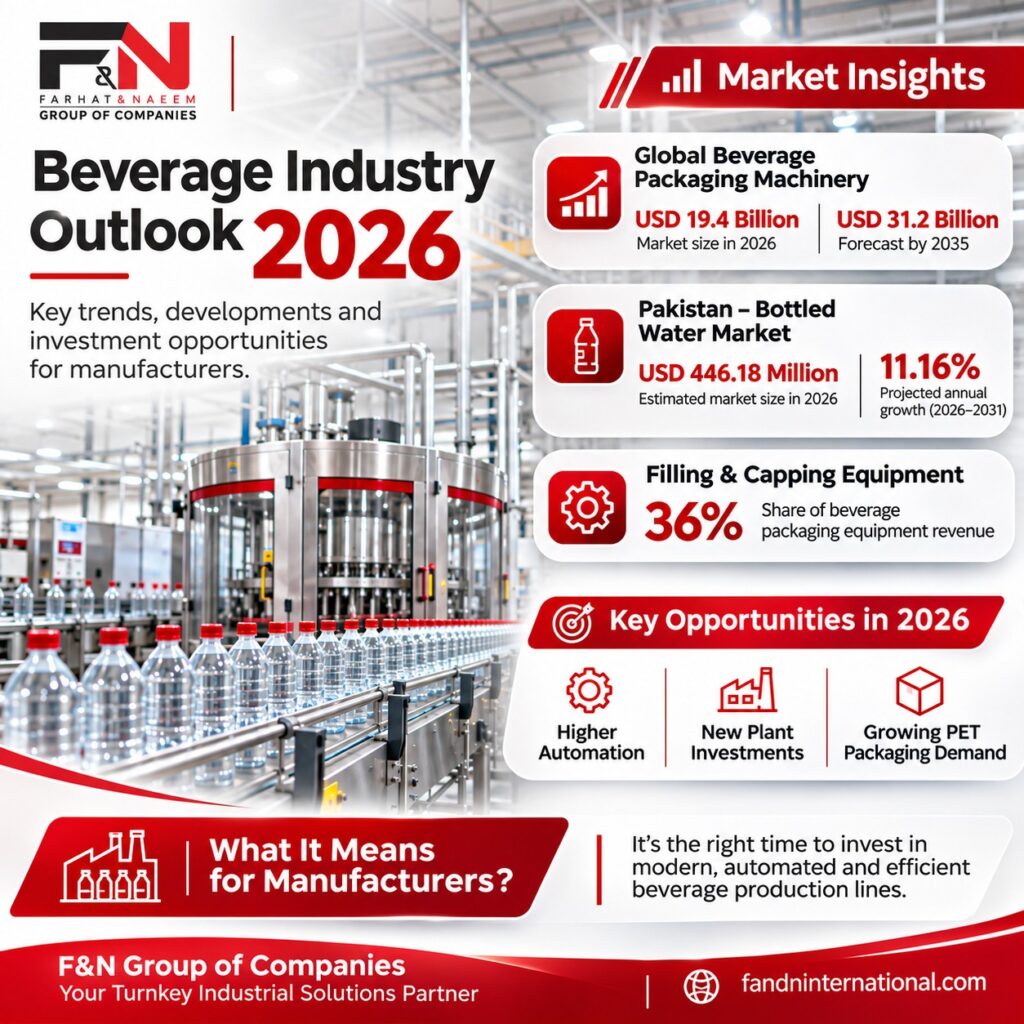
The global beverage industry is entering a new phase of growth, driven by changing consumer preferences, increasing demand for packaged beverages, advanced manufacturing technologies and the growing adoption of industrial automation. For beverage manufacturers, 2026 presents important opportunities to expand production capacity, modernize existing factories and invest in efficient beverage processing and packaging machinery.
From bottled water and carbonated soft drinks (CSD) to juices, energy drinks and functional beverages, manufacturers are increasingly focusing on production efficiency, packaging flexibility, product quality and long-term operational performance.
For factory owners and industrial investors, understanding these developments is essential when planning a new beverage production facility or upgrading an existing bottling plant.
In this article, F&N International explores the major beverage industry trends in 2026, global and Pakistan market opportunities, the role of automation, and the machinery investments shaping the future of beverage manufacturing.
1. Global Beverage Industry Outlook 2026
The global beverage market continues to create opportunities for manufacturers and machinery suppliers. Rising demand for packaged drinks, urbanization, product innovation and improvements in distribution networks are encouraging manufacturers to expand and modernize their production facilities.
According to Global Market Insights, the global beverage packaging machine market is estimated at approximately USD 19.4 billion in 2026 and is projected to reach USD 31.2 billion by 2035, representing a compound annual growth rate (CAGR) of approximately 5.4%.
This growth highlights the increasing importance of advanced filling, capping, labeling and packaging technologies in modern beverage production.
- Increasing demand for packaged drinking water.
- Growth in carbonated soft drinks and ready-to-drink beverages.
- Rising adoption of automated production systems.
- Demand for flexible packaging and multiple bottle formats.
- Greater focus on production efficiency and quality control.
- Investment in modern and scalable manufacturing facilities.
For beverage factory owners, these developments indicate the importance of selecting machinery that can support current production requirements while allowing future expansion.
2. Pakistan Beverage Market: Growing Opportunities for Manufacturers
Pakistan is an important market for beverage manufacturing, particularly in bottled drinking water, carbonated beverages and packaged drinks.
According to Mordor Intelligence, Pakistan's bottled water market is estimated to reach USD 446.18 million in 2026 and is projected to grow to approximately USD 756.94 million by 2031, representing an estimated CAGR of 11.16%.
Growing health awareness, concerns about drinking water quality, urbanization and wider retail distribution are among the factors supporting market demand.
What does this mean for beverage factory owners?
New Bottled Water Plants: Entrepreneurs and investors can explore opportunities in packaged drinking water production with appropriately designed treatment and bottling facilities.
Production Capacity Expansion: Existing manufacturers may consider upgrading their filling and packaging operations to meet increasing demand.
Advanced Packaging Technology: PET bottles, flexible packaging formats and automated labeling systems can help manufacturers serve different product categories and market segments.
Product Diversification: Manufacturers can explore additional beverage categories, subject to market demand, technical requirements and regulatory compliance.
However, market growth alone does not guarantee business success. Product quality, distribution, regulatory compliance, production costs and appropriate machinery selection remain critical.
3. Industrial Automation Is Transforming Beverage Manufacturing
Automation is becoming an increasingly important part of modern beverage production.
Traditional manufacturing operations often involve separate machines and significant manual handling. Modern automated production lines integrate multiple processes to improve production flow, consistency and operational control.
According to PMMI's 2026 industry coverage, manufacturers are increasingly investing in artificial intelligence, automation and smarter packaging equipment to address labor challenges, improve efficiency and reduce operational interruptions.
Key Automation Technologies in Beverage Factories
Automatic Bottle Blowing Machines: PET bottle blowing machines transform PET preforms into finished bottles using controlled heating and high-pressure air. Automated systems help maintain consistent bottle quality and production output.
Automatic Filling and Capping Machines: Modern filling and capping machines automate bottle rinsing, filling and closure application. Integrated systems help manufacturers maintain consistent filling operations and reduce manual intervention.
Automatic Labeling Machines: Bottle labeling machines apply product labels accurately and consistently. Depending on the machine configuration, manufacturers can select OPP, self-adhesive, sleeve or other labeling technologies.
Conveyor Systems: Industrial conveyor systems connect different production stages, allowing bottles to move continuously between blowing, filling, labeling and packaging equipment.
Automatic Shrink Wrapping and Packaging Machines: Packaging automation helps prepare finished products for storage, transportation and distribution with consistent pack presentation.
By integrating these technologies, beverage manufacturers can create a more organized and efficient production environment.
4. Growing Investment in Modern Beverage Production Lines
One of the important developments in beverage manufacturing is the shift from purchasing individual machines toward planning integrated production facilities.
A complete beverage production line must be designed around the product, required production capacity, packaging format, available factory space and future business objectives.
Essential Machinery for a Modern Beverage Production Plant
- Water Treatment System: Purification and treatment equipment designed according to raw water quality and the required finished product specifications.
- PET Bottle Blowing Machine: Equipment for manufacturing bottles from PET preforms.
- Air Conveyor System: Transfers empty bottles from the blowing section to the filling area.
- Bottle Rinsing, Filling and Capping Machine: Performs the primary bottling operations.
- Labeling Machine: Applies labels to finished bottles.
- Date Coding System: Prints production dates, batch information and other required product details.
- Shrink Wrapping Machine: Groups bottles into market-ready packaging.
- Flat Conveyor System: Transfers finished products between packaging and dispatch sections.
- Utility Equipment: Includes compressors, electrical systems and other supporting infrastructure.
The exact equipment configuration depends on the type of beverage, production speed, bottle sizes, packaging requirements and factory layout.
For carbonated soft drink manufacturing, additional equipment such as syrup preparation systems, beverage mixing systems, carbonation units and specialized filling machinery may be required.
5. Energy Efficiency, Packaging Flexibility and Sustainable Manufacturing
Modern beverage manufacturers are increasingly evaluating machinery based on more than production speed.
Energy consumption, water usage, packaging material efficiency, equipment maintenance and operational flexibility are becoming important considerations in machinery investment decisions.
Energy-Efficient Production Equipment
Energy-efficient motors, optimized compressed air systems, improved heating technologies and suitable equipment configurations can help reduce unnecessary energy consumption.
Flexible Bottle and Packaging Formats
Manufacturers increasingly need equipment capable of handling different bottle sizes and packaging formats. A properly selected production line can support multiple product formats through suitable changeover systems and machine configurations.
Water and Resource Management
Water treatment, cleaning-in-place (CIP) systems, process optimization and appropriate wastewater management can support more responsible manufacturing operations.
Recyclable Packaging Considerations
Packaging decisions are increasingly influenced by material efficiency, recyclability and changing customer expectations. Manufacturers should consider packaging compatibility, product protection and local regulatory requirements when selecting machinery.
6. Important Factors Before Investing in Beverage Machinery
Investing in a beverage production plant requires careful technical and commercial planning.
- Production Capacity: Determine the required production output in bottles per hour (BPH). Capacity planning should consider current demand, distribution targets and potential future expansion.
- Product Category: Identify whether the facility will manufacture bottled water, carbonated soft drinks, juices, energy drinks or other beverages. Each product category may require different processing and filling technologies.
- Bottle Size and Packaging Format: Consider the required bottle sizes, neck specifications, packaging materials and product range before finalizing machinery.
- Factory Layout: Plan sufficient space for machinery installation, material movement, utilities, maintenance access, storage and finished goods handling.
- Automation Level: Evaluate whether semi-automatic, fully automatic or integrated production equipment is appropriate for the investment budget and operational requirements.
- Installation and Commissioning: Machinery installation, equipment integration, testing and operator training are important for a successful production startup.
- After-Sales Technical Support: Availability of technical assistance, spare parts, maintenance services and troubleshooting support should be considered before selecting an equipment supplier.
A well-planned investment considers the complete production process rather than focusing only on the purchase price of individual machines.
7. Why Turnkey Beverage Plant Solutions Matter
A turnkey beverage plant solution brings different production systems and supporting infrastructure together under one coordinated project.
Instead of managing multiple disconnected machinery suppliers, manufacturers can work with a turnkey solutions provider to plan equipment selection, production flow, plant layout and installation requirements.
A complete turnkey beverage project may include:
- Project feasibility and technical consultation.
- Factory layout and production planning.
- Water treatment and processing systems.
- PET bottle blowing machinery.
- Beverage filling and capping lines.
- Labeling and packaging machinery.
- Conveyors and utility systems.
- Machinery installation and commissioning.
- Technical support and operator training.
Proper integration helps ensure that individual machines work together according to the required production capacity and operational specifications.
For investors planning a new beverage factory, turnkey project planning can also make machinery selection and project coordination more organized.
8. How F&N International Supports Modern Beverage Manufacturing
F&N International provides industrial machinery and turnkey production solutions for beverage, food, plastics, cosmetics and other manufacturing industries.
With a focus on engineering, machinery integration and production requirements, F&N International supports manufacturers planning new industrial facilities or upgrading existing production operations.
Its beverage industry solutions include:
- Complete bottled water production lines.
- Carbonated soft drink (CSD) production lines.
- PET bottle blowing machines.
- Automatic bottle filling and capping machines.
- Beverage processing and mixing systems.
- OPP and other bottle labeling solutions.
- Industrial conveyor systems.
- Shrink wrapping and packaging machinery.
- Factory layout planning and project consultancy.
- Installation, commissioning and after-sales support.
Whether you are planning a new mineral water plant, expanding a carbonated soft drink facility or upgrading an existing bottling line, selecting the right machinery and production configuration is essential.
F&N International works with manufacturers to develop machinery solutions based on production capacity, product requirements, packaging formats and factory specifications.
Explore our Beverage Industry Machinery and Turnkey Solutions to learn more: https://fandninternational.com/beverage-industry/
9. Future Outlook: What Should Beverage Manufacturers Prioritize?
The future of beverage manufacturing will increasingly depend on operational efficiency, production flexibility, automation and product quality.
For manufacturers planning investments in 2026 and beyond, several priorities deserve attention:
- Modernizing outdated production machinery.
- Improving filling and packaging efficiency.
- Evaluating automated production line integration.
- Reducing unnecessary energy and material consumption.
- Planning production capacity around realistic market demand.
- Improving maintenance and technical support systems.
- Selecting machinery that supports future product diversification.
Manufacturers who make informed investment decisions and plan their production facilities carefully will be better positioned to respond to changing market requirements.
Conclusion
The beverage industry in 2026 offers significant opportunities for manufacturers willing to invest in modern production technologies, efficient packaging systems and properly integrated manufacturing facilities.
Growing demand for packaged beverages, expanding bottled water markets and increasing adoption of industrial automation are influencing how beverage factories are designed and operated.
However, successful manufacturing requires more than purchasing high-speed machinery. It requires careful planning, appropriate equipment selection, production line integration, quality management and reliable technical support.
F&N International is committed to supporting beverage manufacturers with industrial machinery, engineering solutions and complete turnkey production systems.
Planning a new beverage production plant or upgrading your existing factory? Contact F&N International to discuss your project requirements.
Frequently ask question
Here, you’ll find straightforward answers to the most common questions about our machines, the installation process, and complete plant solutions.
